Water stains spreading across your commercial ceiling. Puddles forming inside your building after every rain. The constant drip that never stops.
Fixing a leaking flat roof isn’t something you can put off until next month. Every day that water penetrates your building causes more damage to inventory, equipment, interiors, and your bottom line.
At Prrotect Roofing, we’ve handled hundreds of commercial roof repair emergencies across Missouri and Illinois. We’ve seen businesses lose thousands in water-damaged inventory. We’ve also seen smart property owners who acted fast and minimized their losses.
The difference comes down to understanding the problem. Here are the 5 facts you need to know for successful leaking flat roof repair.
1. The Drip You See Isn’t Where the Leak Is
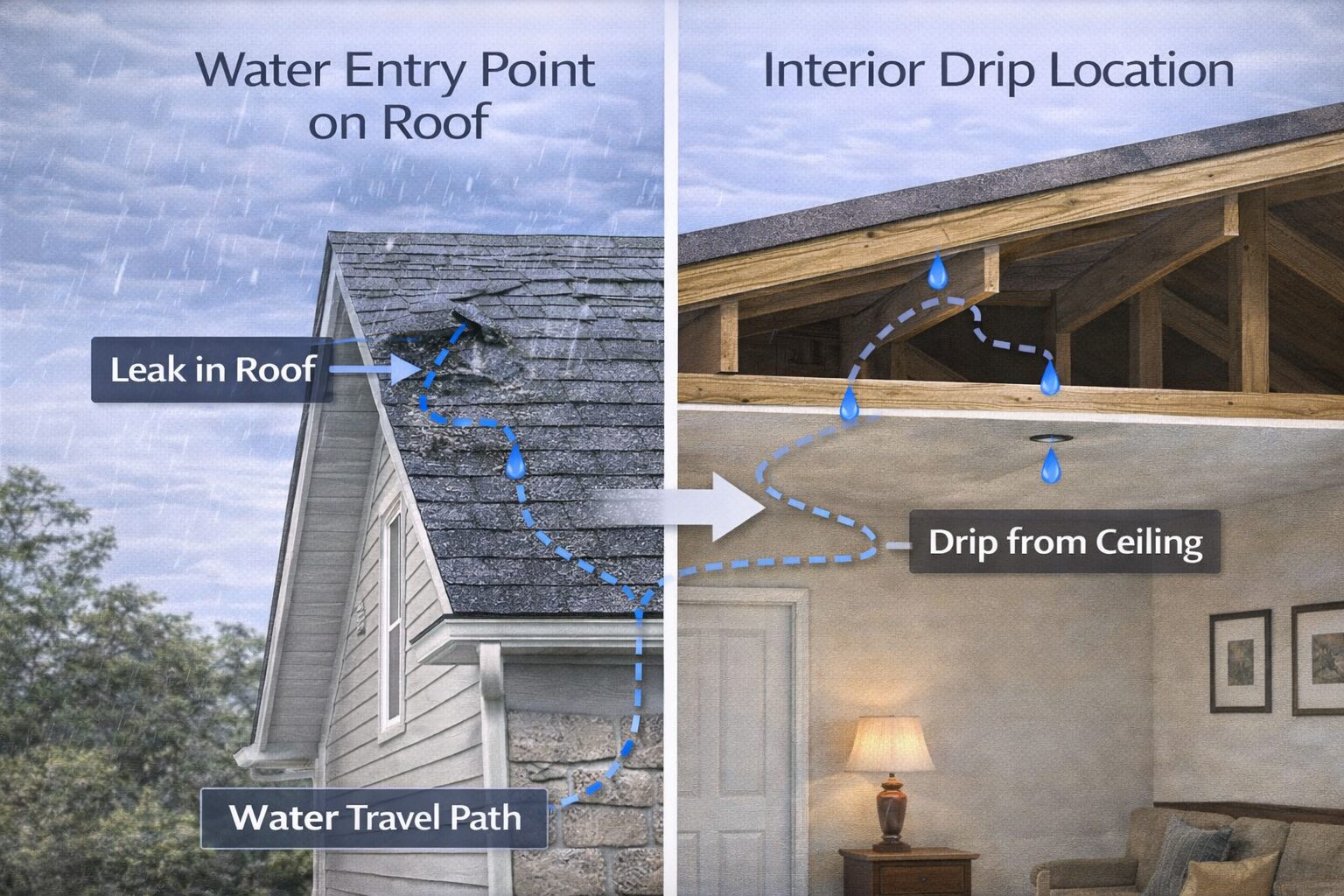
Here’s what catches most people off guard: the leak you see inside your building often isn’t where water is actually entering your roof.
Water enters through a crack, tear, or failed seal. Then, it travels along the underside of your roof membrane or follows deck seams, dripping through the path of least resistance. That drip might be 10–20 feet away from the actual hole.
Why This Matters
Patching the roof directly above the interior drip usually fails. You’re sealing the wrong spot while water continues to pour in through the actual breach.
Professional leak detection methods include:
- Moisture Meters: Detect trapped water in insulation invisible to the naked eye.
- Infrared Thermography: Uses thermal cameras to spot cool “wet” insulation under the membrane.
- Water Testing: Systematically flooding roof sections to trace the exact entry point.
2. Different Materials Need Specialized Repair Methods
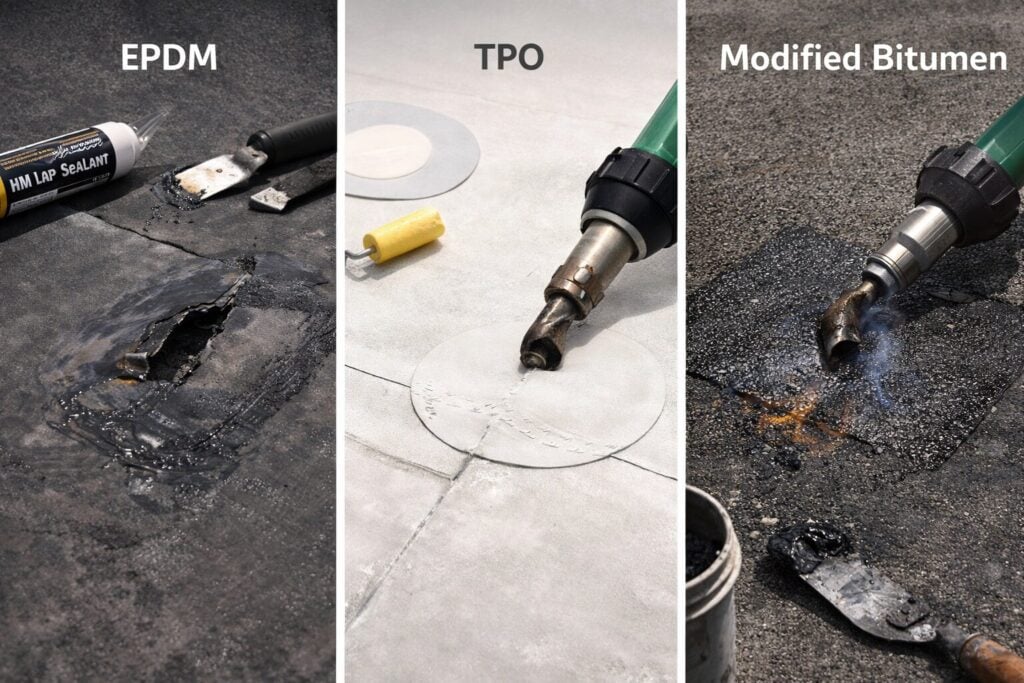
Not all flat roofs are the same. The repair method that works for EPDM rubber will fail on TPO. Using the wrong approach is the fastest way to turn a small repair into a total failure.
EPDM Rubber: Why Glue Patches Fail
Many property owners attempt to patch EPDM with standard adhesive patches, but experts warn against relying on glue alone. As noted in repair demonstrations, “Patches don’t last because… the glue fails that holds the patch down”.
The Better Fix:
For a permanent EPDM repair, we recommend a silicone-based approach reinforced with fleece.
“Nothing can adhere to EPDM like super silicone… The fleece… stretches with the material… look how it sticks… you cannot tear it up.”
Material Comparison Guide
| Material | Type | Repair Method | Critical Note |
| EPDM | Black Rubber | Silicone & Fleece | Standard glue patches often lift over time. Silicone reinforced with polyester fleece provides a bond that stretches with the roof. |
| TPO | White Thermoplastic | Heat Welding | Requires welding at 500-600°F. Adhesives do not bond well; DIY repairs almost always fail. |
| Mod-Bit | Asphalt/Rubber Mix | Torch or Cold App | Can be torch-applied or cold-adhered. Requires multi-layer patches for durability. |
| Emergency | All Types | Acrylic Fiber | Some fiber-reinforced acrylics can be applied even “if it rains immediately afterwards”. |
Pro Tip: TPO roofs are “cool roofs” that reflect heat. Learn more about their energy benefits at the Department of Energy.
3. Ponding Water Makes Repairs More Complex
If water pools on your commercial flat roof for 48+ hours after rain, you don’t just have a leak problem—you have a drainage problem.
Why Ponding is Dangerous
- Accelerates Rot: Constant moisture breaks down adhesives and membranes.
- Hides Damage: You can’t patch a leak that is underwater.
- Acidic Debris: Decaying leaves and dirt in puddles create acids that eat through the roof surface.
The Fix: Simple patching won’t work here. You need to address the drainage by adding tapered insulation, installing new drains (scuppers), or reinforcing sagging deck sections. According to the National Roofing Contractors Association (NRCA), ponding water can reduce a roof’s lifespan by up to 50%.
4. Emergency Repairs Cost More (But Save You Money)
When water is pouring into your building at 11 PM on a Sunday, emergency service premiums apply. Expect to pay 50–100% more for after-hours response. However, this premium is tiny compared to the alternative.
The Cost of Waiting
Without immediate response, secondary damage escalates instantly:
- Mold Remediation: Can cost $2,000–$10,000+ and starts growing within 24 hours.
- Business Interruption: Losing $1,000+ per day in closed operations.
- Inventory Loss: Water ruins electronics, stock, and raw materials.
The Math: A $500 emergency repair that stops water entry immediately beats a $20,000 restoration bill every time.
Expert Insight: In emergency situations where you cannot wait for a pro, specialized “emergency roof repair” products can be used on damp surfaces.
“If you brush away the surface water you can use it and also if it rains it doesn’t matter.”
5. Temporary Fixes Are Not Permanent Solutions
When a professional can’t perform a permanent fix immediately (due to weather or material availability), temporary fixes buy you time. But application technique matters.
The “Squeegee” Technique
If you are applying a liquid coating or emergency patch, thickness is key.
“A good way to check how thick it is is if you see the roller roll it’s too thin… think of it just spreading out like that… runs the bead out there.”
The Scrim Method for Strength
For older roofs requiring a temporary overhaul before replacement, using a “scrim” (glass fiber mesh) adds essential structural integrity.
- Why use scrim? It “guarantees a minimum depth of coating of 2 mm meaning no dry spots”.
- The Benefit: It “adds additional strength which is important if you have lots of cracks”.
| Temporary Fix | Best For… | Lifespan | Warning |
| Heavy-Duty Tarp | Large storm damage | 1–3 Months | Must be weighted and extend 4ft+ past damage. Wind often lifts them. |
| Roof Cement | Small/Medium leaks | 6–18 Months | Surface must be dry. Cement eventually cracks under UV rays. |
| Fiber-Reinforced Acrylic | Damp/Rainy Conditions | 6–12 Months | Can be applied in the rain. Ideal for stopping leaks now. |
Rule of Thumb: Schedule permanent leaking flat roof repair within 30–60 days of a temporary fix to prevent recurring leaks.
Leaking Flat Roof Repair Cost: What You’ll Actually Pay
Understanding real costs helps you budget. Here are average ranges for professional repairs:
- Minor Repair: (Single leak, flashing repair, small patch)
- Cost: $300 – $700
- Medium Project: (Multiple leaks, ponding correction, 50-100 sq ft)
- Cost: $1,200 – $3,500
- Major Repair: (Large section replacement, structural deck repair)
- Cost: $3,000 – $8,000+
- Emergency Premium:
- Add: $200 – $500 (plus weekend/holiday rates)
Note: EPDM repairs are generally 20-30% cheaper than TPO or Modified Bitumen due to simpler application methods.
Prevention: Stop Leaks Before They Start
The smartest repair is the one you prevent.
- Quarterly: Clear all drains and scuppers. Remove debris.
- Preparation is key: Before any repair or maintenance, “thoroughly sweep the surface with a stiff bristled brush” to ensure a dust-free contact.
- Bi-Annually: Schedule a comprehensive commercial roof inspection. Spring checks prepare you for summer storms; Fall checks prepare you for winter ice.
- Every 3-5 Years: Apply reflective coatings to extend membrane life and improve waterproofing.
FAQs About Flat Roof Leaks
What is the best way to repair a leaking flat roof?
There is no single “best” way because it depends entirely on your roof material.
- For EPDM: Standard patches often fail. The best method involves a silicone coating reinforced with polyester fleece, which “stretches with the material” and won’t tear up.
- For Bitumen/Felt: Use a primer (where “less is more”) followed by a sealant and scrim reinforcement to prevent cracks from reappearing.
How much does it cost to seal a flat roof?
If you are looking to coat (reseal) the entire roof to extend its life, expect to pay $1.00 – $3.00 per square foot for silicone or acrylic coatings. If you just need to seal a specific leak, professional spot repairs typically range from $300 to $700. Emergency sealing with tarps or temporary cement can cost an additional $200-$500 for rapid response.
Why is my flat roof leaking in heavy rain?
Heavy rain often exposes drainage failures rather than just membrane holes. If drains or scuppers are clogged with debris, water backs up and rises above the flashing levels (where the roof meets the wall), causing it to pour into the building. Heavy rain also creates “ponding,” where the sheer weight of standing water forces moisture through microscopic cracks that wouldn’t leak during a light shower.
Can I seal a flat roof myself?
You can apply temporary sealants like fiber-reinforced acrylics (which don’t need fleece) to stop a leak in an emergency. However, DIY sealing is rarely a permanent fix. Without proper surface preparation such as ensuring a “dust free dirt free contact” even good sealants will peel off. For a warranty-backed seal, professional application is required.
Get Professional Leaking Flat Roof Repair Today
Don’t let ongoing leaks destroy your building. Every hour allows more water to penetrate your insulation and decking.
At Prrotect Roofing, we provide 24/7 emergency response throughout Missouri and Illinois. We provide transparent pricing, work with insurance, and back our repairs with solid warranties.
Call immediately: (314) 292-9331 for emergency leak response.
Serving St. Louis and the surrounding areas with same-day service.