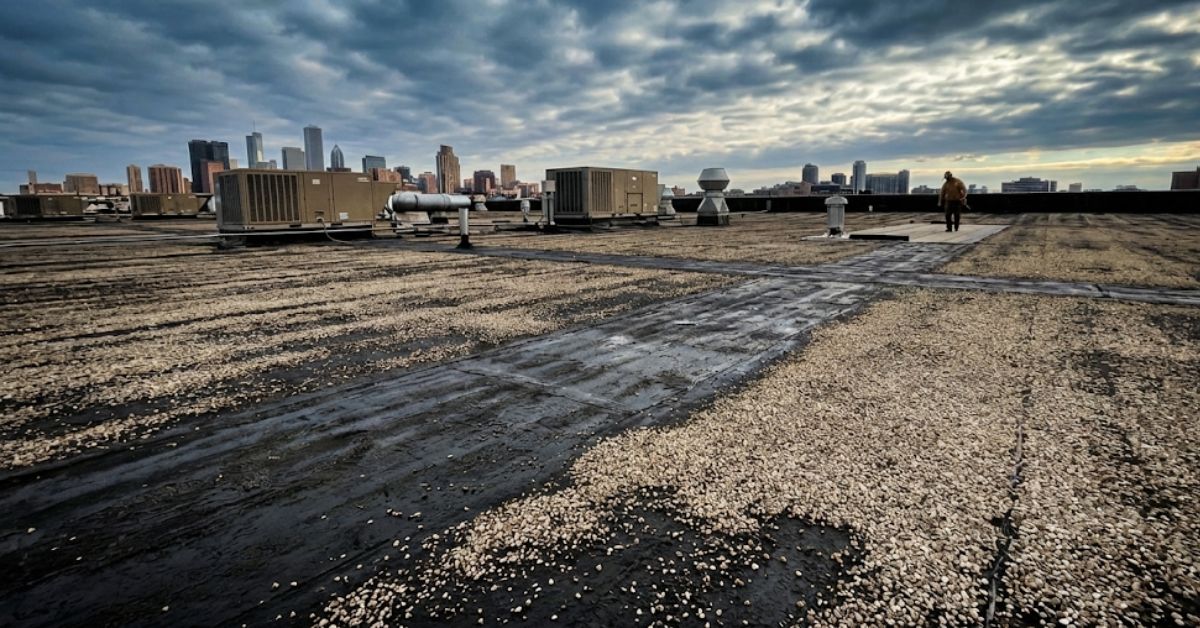
If you look at the commercial skylines of St. Louis, Springfield, or Chicago, you are looking at history. Tar and gravel roofing (technically known as Built-Up Roofing or BUR) has been the gold standard for flat roofs for over a century.
Why? Because it works. It is tough, fire-resistant, and redundant.
However, modern single-ply membranes (like TPO and EPDM) have changed the market. If you are a building owner in Missouri or Illinois, you might be wondering: Is this traditional system still the right choice for me in 2026? Or should I move on?
At Prrotect Roofing, we have installed, repaired, and replaced miles of tar and gravel roofing. This guide cuts through the technical jargon to give you the honest costs, pros, and cons.
What Exactly Is a Tar and Gravel Roof?
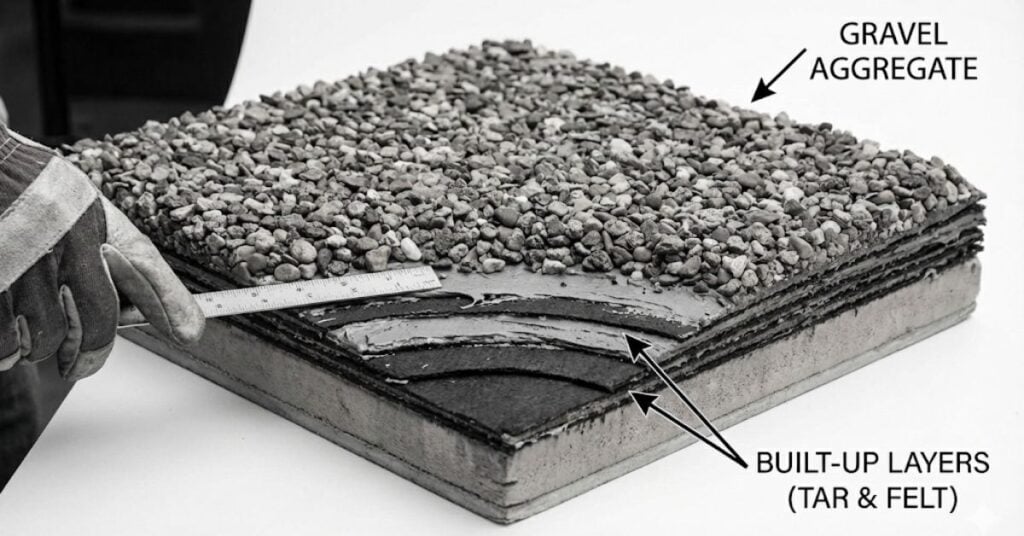
To understand a Built-Up Roof (BUR), think of lasagna. It isn’t one single sheet; it is built in layers.
A tar and gravel roof consists of alternating layers of roofing felt (reinforcement) and hot asphalt (waterproofing).
- 3-Ply System: Three layers of felt/asphalt.
- 4-Ply or 5-Ply: More layers = more durability (and higher cost).
Once these layers are stacked, the roof is flooded with a final coat of hot tar and immediately covered with a layer of aggregate (gravel).
Why All the Gravel?
The gravel isn’t just for decoration. It actually does three critical jobs:
- It Blocks the Sun: Asphalt degrades quickly in UV light. The stones act as “sunscreen” for your roof.
- It Stops Fire: The stone layer makes the roof non-combustible (Class A Fire Rating).
- It Holds Everything Down: The weight keeps the system secure against high winds.
Type of Gravel Roof
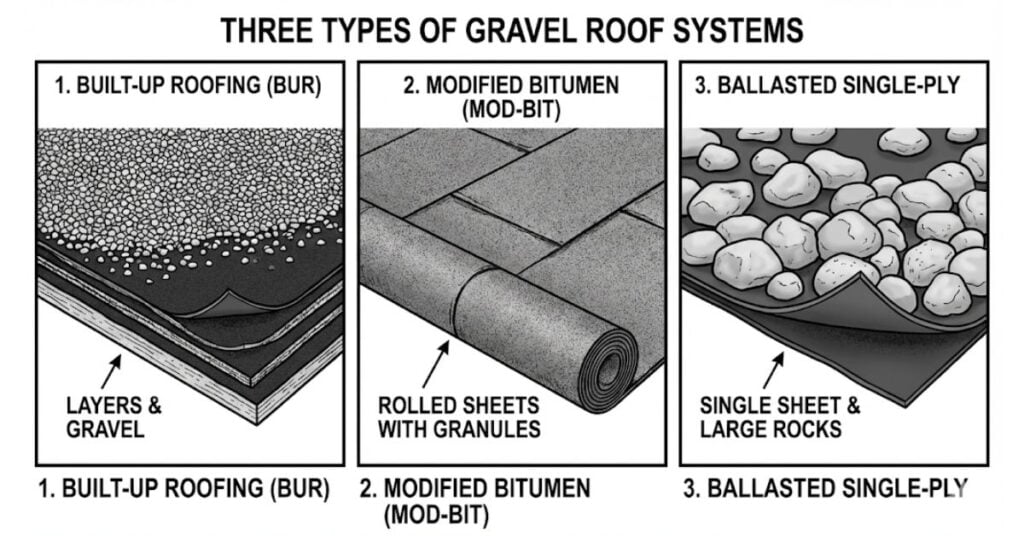
Beginners often confuse these three systems. It is vital to know which one is sitting on top of your building.
1. Traditional Built-Up Roofing (BUR)
What it is: The “Lasagna” method described above.
Best For: Durability and heavy foot traffic.
Status in 2026: Still used, but becoming rarer due to the smell of hot tar and the hard labor involved.
2. Modified Bitumen (Mod-Bit)
What it is: The evolution of BUR. Instead of mopping hot tar, installers roll out factory-made sheets of asphalt that are reinforced with rubber or plastic modifiers.
The Gravel: Sometimes the gravel is embedded in the sheet at the factory, or loose gravel is applied on top.
Best For: Cold climates (it is more flexible than standard tar).
3. Ballasted Single-Ply (The Imposter)
What it is: This is not a tar roof. It is a rubber (EPDM) or plastic (TPO) sheet laid loose over the deck. Large river rocks (ballast) are piled on top to hold it down.
Best For: Ease of repair and cost.
Distinction: If you move the rocks and see a black rubber sheet, it’s Ballasted EPDM, not a Tar & Gravel BUR.
What Will This Gravel Roof Cost You in 2026?
Tar and gravel roofs are labor-intensive. While the materials are cheap, the hard work required to install them impacts the price.
New Installation Costs (Average):
- 3-Ply System: $4.00 – $7.00 per sq. ft.
- 4-Ply System: $5.00 – $8.00 per sq. ft.
- 5-Ply System: $6.00 – $9.00 per sq. ft.
Real-World Example:
For a standard 2,000 sq. ft. commercial building, a new 3-ply tar and gravel roof will typically cost between $8,000 and $14,000.
Note: If you are tearing off an old roof, add $1.00–$2.00 per sq. ft. for disposal.
Is This Roof Right for You?
Why You Might Love It (The Pros)
- Redundancy: If the top layer is punctured, you have 3 or 4 more layers beneath it. It doesn’t leak easily.
- It Eats Hail for Breakfast: The gravel layer acts as a shield. In the Midwest hail belt, this can save your roof from damage that would destroy a TPO roof.
- Fire Safety: It naturally achieves the highest fire ratings without extra chemicals.
- Lifespan: A well-maintained 4-ply roof can last 25–30 years.
Why You Might Hate It (The Cons)
- It’s Heavy: It weighs roughly 10–15 lbs per sq. ft. (compared to 1.5 lbs for TPO). Your building structure must be strong enough to hold it.
- Leaks Are Hard to Find: Because the gravel covers the surface, finding the exact spot of a leak is like finding a needle in a haystack.
- The “Smell”: Installing hot asphalt produces strong fumes. We often have to schedule work on weekends to avoid disturbing your tenants.
Common Questions About Tar & Gravel Roofs
Are tar and gravel roofs good?
Yes, they are excellent for durability and fire resistance. They are especially “good” if your building has heavy foot traffic (HVAC repairmen walking on it) or if you live in an area prone to hail, as the gravel protects the waterproofing layers underneath.
How long will a tar and gravel roof last?
You can expect a lifespan of 20 to 25 years in the Midwest. However, if you keep the drains clear and maintain the gravel coverage, 30 years is possible. Neglect it, and it will fail in 15.
What is under a tar and gravel roof?
Directly under the gravel are alternating layers of hot asphalt and reinforcing fabric (felt or fiberglass). Underneath that “sandwich” is typically a layer of rigid insulation board sitting on top of the structural roof deck (wood or steel).
Can you walk on a tar and gravel roof?
Yes. In fact, it is one of the best roofs for foot traffic because the gravel provides excellent grip and the multiple layers are thick enough to resist punctures from boots. Just be careful loose gravel can be a tripping hazard!
Need an Honest Opinion?
Tar and gravel roofing is a robust, historic system, but it requires specialized skill to install and repair correctly. Many modern roofers don’t even have the equipment to handle hot asphalt anymore.
At Prrotect Roofing, we bridge the gap between historic craftsmanship and modern technology.
Do you have an aging Tar & Gravel roof?
Don’t guess at its condition. Call us today at (314) 292-9331 for a comprehensive commercial roof inspection. We can tell you if a repair will save it or if it’s time to upgrade.